Looking for the best lock board for toddlers? This guide highlights five reliable Montessori-style busy boards that support fine motor skills, problem-solving, and sensory exploration. Each option is suited to different developmental stages and travel needs, from simple latches to LED-enhanced activities. Perfect for parents seeking screen-free, hands-on learning moments for ages 1–3 and beyond.
Summary table of selected products:
| Product | Best For | Key Benefit |
|---|---|---|
| Melissa & Doug Latches Wooden Activity Board | Toddlers 3+ | Classic latches with colorful animal illustrations |
| GNAYUIJ Montessori Wooden Busy Board | Active toddlers who love switches | 10 switches with LED variety for visual feedback |
| ABERLLS Montessori Busy Board | Young toddlers (12–36 months) | Latches, Velcro, zipper and daily-life simulations |
| Joyreal Farm Themed Busy Board | Travel-friendly and imaginative play | Farm-themed features with a music box |
| AXEARTE Montessori Busy Board | 12–36 months | 12 activities including latches, switches, gears |
Melissa & Doug Latches Wooden Activity Board

The Melissa & Doug board uses six metal latches that hook, snap, click, and slide to reveal colorful animal illustrations behind each door. This classic setup is ideal for developing dexterity, hand-eye coordination, and problem-solving in preschoolers. It’s best for toddlers who enjoy tactile feedback and simple, tangible challenges. A modest caution is that the straightforward design may be less engaging for children who crave highly varied activities in a single session.
Best for: Toddlers who benefit from concrete, hands-on latch play and vivid imagery. Great as an introductory lock-board experience and a staple in Montessori-inspired play spaces.
GNAYUIJ Montessori Wooden Busy Board

This busy board emphasizes 10 distinct switches, each paired with color or LED activity. It enhances dexterity, eye-hand coordination, and cognitive development while offering tactile and visual stimuli. It requires 2 AAA batteries (not included), and its natural wood construction minimizes concerns about paint chipping. Choose this if you want a visually dynamic board with multiple independent activities in one unit.
Best for: Toddlers who enjoy varied, color-coded switch activities and LED feedback, with a Montessori-forward approach to practical skills.
ABERLLS Montessori Busy Board
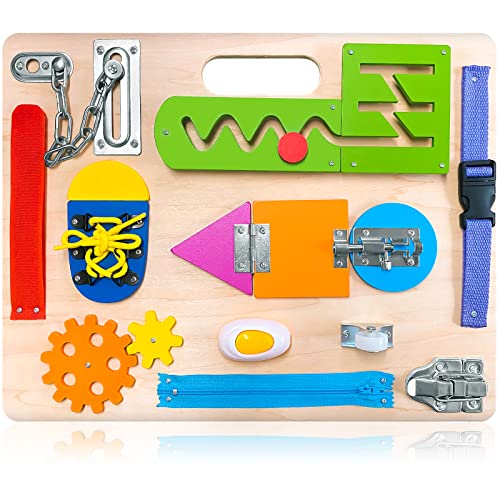
ABERLLS offers a versatile set of latches, Velcro, zippers, gears, keys, and buttons designed to reflect daily life. It supports cognitive development and fine motor skills, with emphasis on independence and problem-solving. The board is described as safe and durable with smooth edges. Best for younger toddlers who need a broader range of simple life-skill simulations in one platform. A potential limitation is the complexity of some activities for very early 12–15 month-olds.
Best for: Young toddlers developing practical life skills, with a broad mix of latches and everyday-object simulations.
Joyreal Farm Themed Busy Board

Joyreal’s farm-themed board features 10 life-skill activities with a manual wind-up music box and a zipper, plus interlocking gears. It supports fine motor skills and hand-eye coordination while unlocking curiosity through peeks at farm animals behind each door. Designed for travel and screen-free engagement, it suits families seeking portable options. A caveat is that some children may prefer non-music boards for quieter play.
Best for: Travel-friendly, engaging play with a farm theme and a music element to capture attention during commutes or quiet days at home.
AXEARTE Montessori Busy Board

AXEARTE presents a 12-activity Montessori-inspired design including latches, switches, gears, locks, zippers, and buttons. The board emphasizes cognitive development, finger control, and practical life skills, with smooth wooden materials and secure components. It’s well-suited for parents who want a comprehensive, durable learning board that covers a broad set of everyday skills. A limitation might be the larger size of the unit for travel-intensive households.
Best for: Families seeking a broad, all-in-one activity board that mirrors daily-life tasks and reinforces practical skills.
Buying Guide: How To Choose The Right Toddler Lock Board
- Age and development stage: For 12–18 months, begin with fewer, larger latches and simple zips. For 2–3 years, look for boards with diverse mechanisms and multiple small parts to boost dexterity.
- Learning goals: If your aim is practical life skills, prioritize boards with locks, zippers, and real-life objects. If you want visual stimulation, choose boards with LED lights and colorful switches.
- Material and safety: Prefer natural wood with smooth edges and secure hardware. Avoid boards with loose parts or rough finishes for younger toddlers.
- Portability and travel needs: For car trips or flights, select compact, travel-friendly designs with little setup. Consider boards with built-in music boxes only if quiet environments are guaranteed.
- Maintenance and durability: Check for sturdy hinges and screws. Some boards require batteries; factor ongoing costs and replacements into your planning.
- Engagement and variety: A multi-activity board maintains longer interest. Balance between mechanical latches and sensory elements like lights or textures.
FAQ
- What age is best for a lock board? Most boards suit ages 12 months and up, with increasing complexity suitable through ages 2–3 years as fine motor skills develop.
- Are LED-light boards safe for toddlers? Yes, when built with low-voltage LEDs and secure components. Do not leave loose batteries or exposed wires within reach.
- Do these boards require batteries? Some models include music or LED features that need batteries. Check each product’s requirements before purchase.
- Which board travels best? Travel-friendly boards are compact, lightweight, and often include magnetic closures or flat profiles for easy packing.
- What makes a busy board Montessori-friendly? A Montessori-friendly board emphasizes practical life skills, self-directed exploration, and independent problem-solving with age-appropriate challenges.
- Can these boards replace screen time? They are designed to be screen-free activities that encourage tactile exploration and concentration, suitable as substitutes or supplements to digital entertainment.