Answering the common question for new parents: the best sturdy walkers for babies are those that offer stable construction, engaging activities, and adjustable features to grow with little ones. This guide highlights five reliable options, clarifying who each is best for and why. Each product is evaluated for safety, play value, and ease of use to help you choose confidently.
Buying at a glance: the table below compares key aspects of five recommended walkers to aid quick decision-making.
| Product | Best For | Why Pick |
|---|---|---|
| Smart Steps Trend Activity Walker and Entertainer | Active babies who love removable toys | Removable STEM toys, large tray, adjustable height |
| Melissa & Doug Deluxe Chomp and Clack Alligator Walker | Engaged toddlers who enjoy wooden, tactile play | Wooden construction with interactive features |
| Smart Steps Trend Activity Walker with Toy Bar | Walkers who benefit from a modular toy bar | Removable toy bar, large tray, multi-direction wheels |
| Fisher-Price Laugh & Learn Smart Stages Sis Walker | Babies who benefit from learning content | Three Smart Stages with 75+ songs and activities |
| Bautia Wooden Montessori Walker | Parents seeking natural wood and rich activities | Natural wood, multiple activity panels |
Notes: Each product is described with who it’s best for, the main features that impact use, and any practical limitations. The sections below present a concise, comparison-friendly view to help you decide which walker aligns with your child’s needs and your home setup.
Smart Steps Trend Activity Walker And Entertainer

Best for: babies who crave on-the-go toys and practical storage. This walker features removable STEM toys that can travel with the child, a large surround tray for snacks or toys, and three-height adjustment levels to accommodate growing infants. The flat-fold frame facilitates easy storage when not in use. Caution: ensure toys are securely reattached after transport to avoid small parts being misplaced during play.
Melissa & Doug Deluxe Chomp And Clack Alligator Walker

Best for: parents who prefer a wooden walker with engaging, hands-on activities. This wooden model offers three chomping alligators, moving fish, a spinning butterfly and ladybug beads, and the alligators’ mouths open and close as the child pushes. It helps with hand-eye coordination and sensory exploration. Limitation: heavier wood may be less portable and slightly bulkier for compact spaces.
Smart Steps Trend Activity Walker With Toy Bar

Best for: families wanting modular play components and easy height customization. This model includes a removable toy bar, a large tray for food or toys, multi-directional front wheels, and a three-position height adjustment with a high-back seat for added support. Caution: ensure the toy bar is securely attached during use to prevent accidental detachment.
Fisher-Price Laugh & Learn Smart Stages Sis Walker
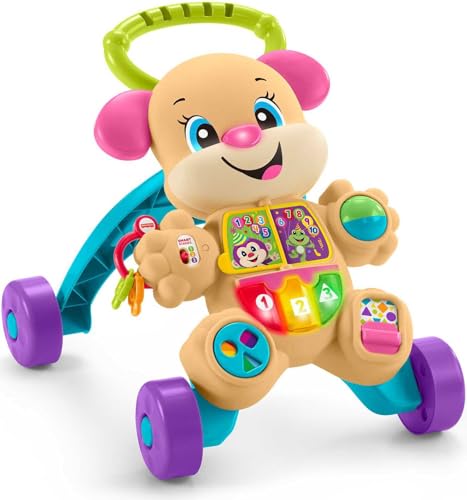
Best for: infants ready to explore with music and education. This walker grows with the child through three Smart Stages levels and more than 75 songs, sounds, and phrases teaching alphabet, shapes, colors, numbers, and basic Spanish words. The hands-on activities include an illuminated piano, a nose, roller, spinner, and flip-page features. Limitation: the abundance of sounds may be overstimulating for some babies or households seeking quieter play.
Bautia Wooden Baby Walker Montessori Walker

Best for: parents seeking a natural wood walker with a robust activity panel. This model combines a rolling letter wheel, a xylophone, flip board, and a tracking game with a sturdy wooden frame. The wooden construction is designed for smoother floor interaction and a calm aesthetic. Caution: wood finishes may require occasional care to prevent chipping or rough edges, and you should check for any small parts that could detach during play.
Buying Guide
What to look for when choosing a baby walker
Stability and frame strength are essential to prevent tipping and to support growing walkers. Look for wide bases, low centers of gravity, and smooth-rolling wheels. Adjustable height helps accommodate your child’s height and step development.
Age and development considerations
Most walkers are designed for babies around 6 months and up. If your child is not yet sitting or has limited leg strength, consider walkers with supportive seats and age-appropriate activities to avoid frustration.
Activity features and safety
Walkers with removable toy bars or trays offer flexible use and easier cleaning. Ensure any removable toys detach securely and are not a choking hazard. Always supervise use on flat, clear surfaces and remove stairs or hazards from the area.
Material and care
Wooden walkers provide a natural aesthetic and durable build, but may require more maintenance. Plastic and metal frames are often lighter and easier to wipe down. Check for smooth edges and non-toxic finishes regardless of material.
Portability and storage
Flat-fold or compact designs help when storage space is limited. Consider models with easily removable components if you need to transport or store frequently.
Frequently Asked Questions
- What age is best for using a baby walker? Generally 6 months and older, once the baby can sit up and has some trunk control, but always follow the manufacturer’s age guidance and supervise closely.
- Are wooden walkers safer than plastic ones? Both can be safe when well-made. Wooden walkers often provide sturdiness and natural durability, while plastic walkers may be lighter and easier to move.
- Do walkers help babies learn to walk? They can support early mobility by providing stability, but independent walking depends on muscles development and practice. Use them as a toy and support tool, not a substitute for supervision and floor time.
- What features improve safety? A wide base, low center of gravity, non-slip wheels, and secure toy attachments are key. Avoid models with loose or detachable small parts.
- Can walkers be used on stairs? No. Always keep walkers away from stairs and use safety gates to restrict access to multi-level areas.
- How do I clean walkers with removable toys? Detach removable components and wash according to product guidelines with mild soap and water; dry thoroughly before reassembly.