Answering your search for the best walker for a baby’s age, this guide highlights five walkers that suit infants from roughly 6 months up to toddler transitions. Each option is evaluated for early gross-motor support, engaging activities, and age-appropriate design. Best for sit-and-begin-walkers, best for active toddlers, and best for portable play, this list helps caregivers choose confidently. The following table summarizes key details to compare quickly.
| Product | ||
|---|---|---|
| Fisher-Price Laugh & Learn Smart Stages Puppy Walker | Toddlers starting to stand | Two ways to play; Smart Stages learning; music and lights |
| VTech Sit-to-Stand Learning Walker | Infants ready to stand and cruise | Removable activity panel; portable on carpet or bare floors |
| Bright Starts Tiny Trek 2-in-1 | Early walker with detachable piano | Two modes: walker and toddler toy; jungle theme |
| HYES 5 in 1 Baby Push Walker | Rise-and-wumble learners; active exploration | 5 modes; adjustable speed; color/shape play |
| Baby Einstein Around We Grow 4-in-1 Walker | Longer play and multi-activity center | 4 modes; sits-to-stand to table; 360° movement |
Fisher-Price Laugh & Learn Smart Stages Puppy Walker

The Puppy Walker is best for babies who start with sit-and-play and transition to standing. It includes two play modes that grow with your child and offers more than 75 songs, sounds, and phrases across three Smart Stages, teaching basics like alphabet, shapes, colors, numbers, and Spanish words. The light-up piano keys, nose, roller, spinner, and other activities promote fine motor skills and sensory exploration. This pick is well-suited for infants around 6 months who are beginning to stand with support and enjoy musical interaction. A potential limitation is that some features require batteries and can overwhelm very young beginners if not guided by a caregiver.
- Best for: Early walkers who enjoy musical play and language concepts.
- Why chosen: Encourages standing and stepping with engaging, progressive learning.
- Caution: Activities may be more engaging for older babies; supervision recommended.
VTech Sit-to-Stand Learning Walker
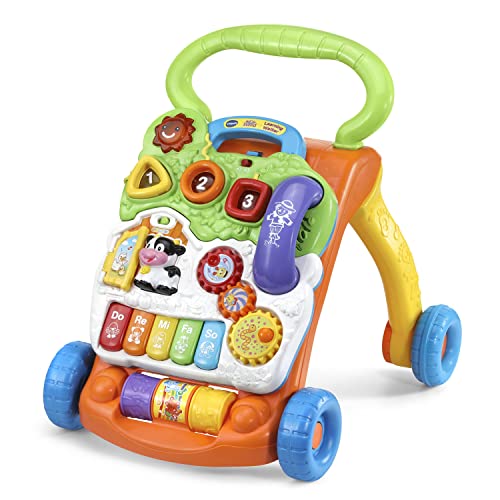
The VTech Sit-to-Stand Walker is ideal for babies who can sit up and are ready to cruise. The removable activity panel makes it portable for on-the-go play, and the walker travels smoothly on carpet and hard floors. It introduces early motor skills with five piano keys for musical notes, a pretend telephone, shape sorters, and color-driven rollers. Best for: infants who benefit from a modular play surface that can be detached for floor play. Limitations include fewer modern interactive features compared to some newer models.
- Best for: Sit-to-stand beginners seeking a compact, versatile walker.
- Why chosen: Simple, durable design that transitions from table to walker quickly.
- Caution: May feel less feature-rich to older toddlers seeking more activities.
Bright Starts Tiny Trek 2-in-1

The Tiny Trek is best for families seeking a two-in-one solution: a walker and a detachable piano toy. It supports exploration with a sturdy frame, adjustable height, and a back-supportive seat. In walker mode, it helps babies practice stepping while enjoying lights and sounds from the piano. In toddler mode, the piano can serve as a standalone toy, extending use beyond the walking phase. A caution: height and weight limits should be checked to ensure it fits your child’s growth trajectory.
- Best for: Early walkers who want a portable, two-in-one option.
- Why chosen: Flexible use with engaging music and animal sounds.
- Caution: Ensure proper height for comfort and safety as baby grows.
Fisher-Price 4-in-1 Snack Cart Walker
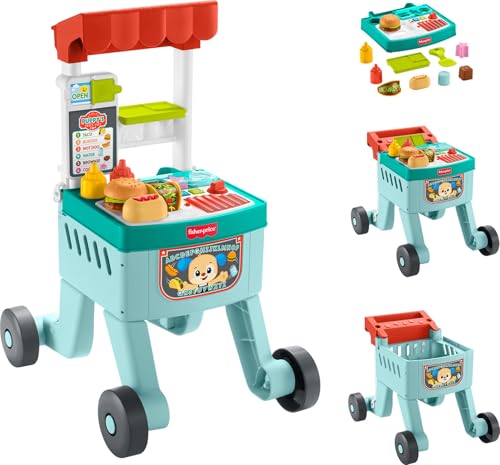
This 4-in-1 walker emphasizes pretend play and conversational learning. The snack-cart design supports early role-play, while the 3 Smart Stages introduce fundamentals like opposites, numbers, shapes, and the alphabet across multiple languages. With 135+ songs, sounds, and phrases and interactive features such as lights, a globe language button, and a cooler door, it offers a broad sensory experience. Best for: families seeking multi-language and multi-activity engagement. Caution: the feature set can feel busy for very young babies just learning to stand.
- Best for: Extended play with language options and practical pretend play.
- Why chosen: Diverse activities support cognitive and motor development.
- Caution: Complex setup may be overwhelming for the earliest stages of walking.
Baby Einstein Around We Grow 4-in-1 Walker

The Baby Einstein Around We Grow 4-in-1 Walker is designed for longer play and multiple learning modes. It transitions from a sit-in stationary walker to a walk-around sensory table and a toddler art table, with five detachable floor play stations. The sit-in mode offers adjustable height for a precise fit, and the set travels 360 degrees around the table while remaining stationary. Best for: families seeking a long-term, cooperative play setup that evolves with the child. Note: Some users may prefer simpler configurations for younger infants just starting to stand.
- Best for: Multi-purpose engagement across the early years.
- Why chosen: Offers varied play surfaces and motion without needing multiple separate toys.
- Caution: May require more space than single-purpose walkers.
Buying Guide: Key Buyer’s Considerations For Baby Walkers
When choosing a walker for a baby’s age, consider how the product supports movement, safety, and learning play. Look for height adjustability to accommodate growth, sturdy bases to prevent tipping, and engaging activities that promote motor skills without overwhelming the child.
What age should a baby start using a walker?
Most walkers are designed for babies around 6 months or older who can sit up independently and have core strength to support short standing periods. Walkers that convert to tables or sit-to-stand modes can extend use into the toddler years.
What features matter most for safety?
Look for a wide base, secure seat with a high back, non-slip wheels, and intuitive locking mechanisms. Smooth edges and sturdy construction reduce pinch points. Avoid walkers with small detachable parts that could pose choking hazards for younger babies.
How to pick the right activity level?
Choose an option with a mix of interactive elements (piano keys, lights, shape sorters) that match your child’s current interest. Moderately challenging activities encourage exploration without causing frustration.
Are 4-in-1 or 2-in-1 walkers better?
4-in-1 designs often provide longer-term value by adapting to growth, while 2-in-1 models focus on portability and quick transition between modes. Your choice depends on space, budget, and how long you expect to use the walker in various forms.
What about language and cognitive learning?
Walkers with multilingual audio options and shape/letter activities can support early literacy. Consider parents’ preferred languages and the child’s responsiveness to musical cues and spoken words.
Maintenance and cleaning
Pick models with removable trays or easy-to-clean surfaces. Machines with fabric seats should be easy to wipe. Ensure parts that come into contact with food are dishwasher-safe or easily washable.
Frequently Asked Questions
- Q: At what age should you stop using a baby walker? A: Move away from walkers as balance and walking confidence grow; transition to floor play when the child can walk steadily.
- Q: Are walkers safe for all babies? A: When used with adult supervision and appropriate age/weight guidelines, walkers can be safe, but avoid long, unsupervised sessions and use on safe surfaces.
- Q: Do walkers help with walking development? A: They support leg movement practice, but true walking development also requires floor time and guided support from caregivers.
- Q: Which features deliver best value? A: Models with adjustable height, secure fastenings, and a mix of cognitive and motor activities tend to offer broader development benefits.
- Q: How do I store a walker when not in use? A: Choose models with foldable frames or compact designs that fit in small spaces, and store away from stairs and clutter.
- Q: Can walkers be used for travel? A: Some models are designed with portability in mind, including detachable play panels and lightweight frames for easy transport.