Finding the right seat for a 6-month-old helps support upright posture, encourages exploration, and frees your hands for feeding or chores. These seats are designed to stabilize a baby who is beginning to sit up, and many convert as your child grows. Below are five well-rounded options suited for babies around six months old, with notes on who each product is best for and practical considerations to keep in mind.
Buyer’s quick reference table:
| Product | Best For | Growth & Use | Key Limitation |
|---|---|---|---|
| Fisher-Price Sit-Me-Up Floor Seat | Traveling families or minimal-space homes | Portable, folds flat for storage | Limited to seated play unless used with baby’s guidance |
| Infantino 3-in-1 Discovery Seat | Multi-purpose from playtime to meals | Grows with baby up to 4 years | Some assembly may be needed for transitions |
| Bright Starts Pop ‘N Sit | On-the-go families needing compact setup | 3 modes; includes carry bag | Tray and pad care may require cleaning |
| Ingenuity Baby Base 2-in-1 Slate | Booster training with dining chairs | Converts from baby booster to toddler seat | Small footprint; tray size may limit larger plates |
| Baby Einstein SuperSeat Touch of Tunes | Engaging play plus snacking | 3-in-1 seat with music and lights | Rotation tray may require adult assistance for some uses |
Fisher-Price Sit-Me-Up Floor Seat With Toys

Best for portability and space-saving needs. This seat provides a wide, sturdy base and cushy seat to help a six-month-old sit upright during playtime. It folds compactly for travel or storage, making it ideal for families who travel or have limited room.
Who it’s best for: caregivers who want a lightweight, quick-to-pack option for floor play or travel. Why selected: compact design and machine-washable seat pad simplify upkeep and use in small spaces. Caution: not a high-chair or feeding seat; best used for supervised floor play or brief supervised sits.
Infantino 3-in-1 Discovery Seat & Booster
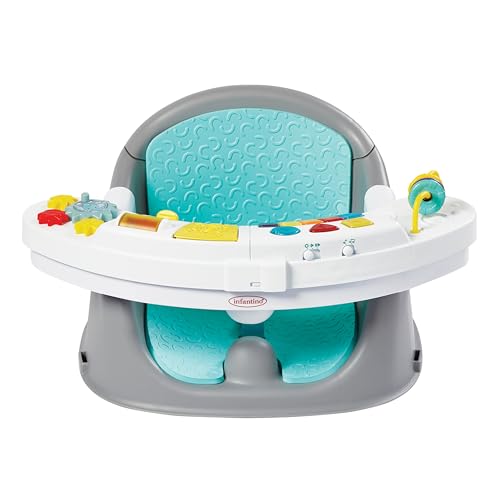
Best for growing with baby from early playtime to meals. This 3-in-1 design transitions from a baby activity center to a snack seat and a dining-table booster, supporting development through motion, light, and sound. It’s designed for use from about 4 months up to 4 years (up to 33 lbs).
Who it’s best for: families seeking long-term value with a single seat that evolves with the child. Why selected: built-in music and lights plus a hidden snack tray support easy transitions from play to eating. Caution: assembly and transitions may require adult supervision to ensure stability during changes.
Bright Starts Pop ’N Sit Portable Booster Seat

Best for on-the-go use with multiple modes in a compact package. This 3-in-1 seat functions as a floor seat, feeding chair with a removable tray, and a toddler booster. It’s suited for indoor and outdoor use and comes with a carry bag for portability.
Who it’s best for: families who need a versatile, portable option for travel or outings. Why selected: compact fold and dishwasher-safe tray make daily cleanup easier. Caution: ensure the seat is properly secured to a chair when used as a booster.
Ingenuity Baby Base 2-in-1 Slate

Best for families who want a seat that grows with their child and fits standard dining chairs. This 2-in-1 booster floor seat combines a secure harness, adjustable chair attachment, and a self-storing tray. It supports up to 33 lbs.
Who it’s best for: households seeking a value-first booster that can transition to a toddler seat. Why selected: tray size accommodates typical plates, and the seat straps store under the unit for neat storage. Caution: tray removal and reattachment should be done carefully to maintain stability.
Baby Einstein SuperSeat Touch of Tunes

Best for interactive learning and snacking in one seat. This 3-in-1 activity seat supports a baby from sitting up through early toddlerhood, featuring a detachable piano, toy bar, bubble popper, and rotating tray with built-in compartments.
Who it’s best for: parents seeking engaging entertainment alongside practicing sitting. Why selected: the music and language variety can aid early cognitive development. Caution: the rotating tray may require assistance to position while younger babies learn to sit independently.
Buying Guide: Key Considerations For Choosing A Seat For A 6-Month-Old
What to look for in safety and stability
Choose seats with a wide, non-slip base and a secure harness or safety straps. Stability matters as babies begin to push up and reach for toys. Look for seats with simple, secure buckles and durable materials that hold shape under a baby’s movement.
How long a seat will be useful
Consider whether you want a seat that grows with your child. Multi-stage seats (from floor seating to booster) can extend use beyond six months, offering better long-term value and reduced clutter.
Convenience and maintenance
Machine-washable seat pads and dishwasher-safe trays save time. Check for easy-clean surfaces and whether parts are easy to remove for cleaning. Portability, foldability, and storage options also impact daily use.
Versatility vs. dedicated function
Some seats are designed for snacking, others for play, and some combine both. Determine whether you need a seat mainly for play, feeding, or a combination to match your routine and space.
Age range and weight limits
Ensure the seat supports your baby’s current weight and has a clear age or weight range. Some products convert to toddler seating, which helps in extending the seat’s usefulness as the child grows.
Environmental and material considerations
Look for BPA-free trays and non-toxic fabrics. For families with frequent travel or outdoor use, a seat with durable construction and weather-ready features can be beneficial.
Frequently Asked Questions
- What is the best seat for a 6-month-old who tries to stand up?
Answer: A stable floor seat or early booster with a secure harness and anti-slip base is recommended to prevent tipping while supporting upright posture. - Can a 6-month-old use a booster seat?
Answer: Some boosters are designed to be used once a baby sits up unassisted, typically around 6 months to 9 months, but always follow manufacturer guidelines and supervise closely. - Are multi-function seats worth the extra cost?
Answer: If you want longer use and less furniture, a 3-in-1 seat can be more cost-effective and space-efficient over time. - Do these seats fit normal dining chairs?
Answer: Many booster seats are designed to attach to standard dining chairs with adjustable harness systems, but verify chair compatibility in the product details. - Is a machine-washable seat pad important?
Answer: Yes, for easier cleanup, especially with drool, snacks, and minor spills common with infants learning to sit and explore. - What is the weight limit for most 6-month-old seats?
Answer: Most models support around 22–33 pounds, but confirm each product’s maximum weight on the official listing.