Answering the search for a reliable baby monitor, this guide highlights five top picks that emphasize breathing movement, sleep position, and gentle alerts. Designed for different parenting needs, these monitors range from wearable sensors to non-contact pads and camera options. Best for non-wearable convenience, best for travel, best for wireless simplicity, and best for total room coverage are covered here. Each product is evaluated on ease of use, alert mechanisms, and suitability for various infant stages.
| Product | Best For | Key Benefit |
|---|---|---|
| Sense-U Pro | Active sleepers & travel | Clip-on, long battery life |
| Baby Oxygen Monitor by Billlesh | Data storage & app view | Built-in memory for sessions |
| Babysense 7 | No-wiFi, crib coverage | Under-mattress sensors |
| Levana Oma Sense | Gentle wake stimulation | Non-contact, vibrations |
| GoodBaby 5″ Monitor | Live video with long range | Remote pan/tilt, night vision |
Sense-U Pro Baby Breathing Monitor With Gentle Alerts

The Sense-U Pro tracks abdominal movement, sleep position, and temperature trends to keep caregivers informed around the clock. It offers gentle vibrations if movement pauses for 15 seconds, followed by an audible alert and app notification if movement does not resume. This makes it suitable for parents who want real-time, tactile cues for unsettled sleep. Best for families seeking a clip-on, portable monitoring solution for home and travel.
Best for: Parents who need continuous, non-intrusive monitoring with both app and audible alerts.
Why selected: It combines movement sensing with temperature tracking and long battery life in a compact clip-on form.
Caution: The device relies on single-point movement data and app connectivity; ensure your phone remains within range for alerts.
Billlesh Baby Oxygen Monitor With Bluetooth App

This monitor tracks heart rate, oxygen level, and baby sleep metrics, with built-in memory that stores up to four sessions. The data syncs to a mobile app within Bluetooth range, enabling parents to review overnight trends. It’s best for caregivers who value retrospective data review without needing constant WiFi access. A practical choice for homes with stable Bluetooth connectivity.
Best for: Parents who want summarized sleep and breathing data available offline and on demand.
Why selected: The built-in memory ensures data retention across device disconnects.
Caution: Data accuracy depends on proper device placement and stable app pairing.
Babysense 7 Non-Wearable Sleep Monitor
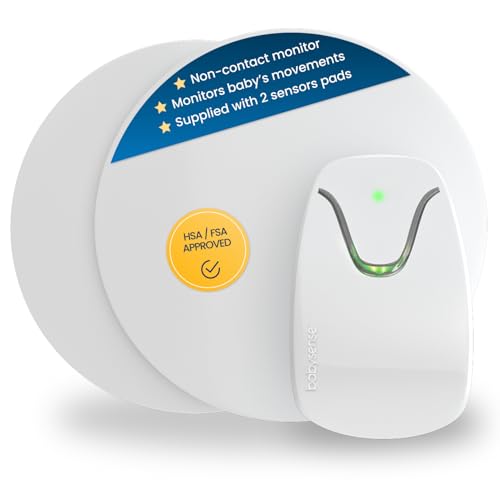
Babysense 7 uses two under-mattress sensors to provide non-contact monitoring with crib-wide coverage. It’s approved for use with certain health plans (FSA/HSA eligibility) and offers quick detection of movement pauses. Best for households prioritizing a non-wearable setup with a strong cribsensing capability.
Best for: Non-contact monitoring with wide crib coverage.
Why selected: The dual-sensor system reduces false alarms and provides continuous monitoring without wearing a device.
Caution: Setup requires proper crib mattress placement; ensure sensors align correctly to detect movements accurately.
Levana Oma Sense Portable Breath Monitor

Oma Sense emphasizes patented Wakeup Technology to monitor abdominal movement and alert parents if movement ceases. It employs gentle vibrations to stimulate movement and emits audible alerts if sleep disruption persists. Best for parents seeking a wearable-free option with a focus on stimulating normal breathing rather than just alerting to risk.
Best for: Sleep-stimulating monitoring for infants without skin contact.
Why selected: Non-contact design plus vibration-based wake-up helps reduce extended episodes of stillness.
Caution: Effectiveness depends on consistent alignment with the baby’s abdomen and correct placement.
GoodBaby 5″ Monitor With Camera And Night Vision

This monitor provides a 5-inch HD display, remote pan/tilt/zoom, night vision, and a range up to 960 feet. It also runs on a long-lasting battery and offers two-way talk and lullabies. Best for caregivers who want live video with broad room coverage and simple controls, especially in larger nurseries or multiple rooms.
Best for: Parents needing live video with broad room coverage.
Why selected: The remote camera features provide flexible viewing angles and child-friendly lullabies.
Caution: Video quality can be affected by interference; ensure a clear line of sight within range.
HelloBaby 5″ No-WiFi Video Baby Monitor

This non-WiFi monitor uses FHSS 2.4GHz digital transmission to provide a secure connection between camera and monitor. A 5″ color display, 355° pan, 120° tilt, and 2X zoom offer wide visibility. Night vision and a two-way talk feature support parental interactions from another room. Best for households avoiding internet exposure altogether.
Best for: Families seeking a secure, non-internet-connected video monitor.
Why selected: The FHSS technology minimizes external interference and maintains privacy.
Caution: Still requires careful setup to avoid video lag or dropouts in busy wireless environments.
VTech DM111 Audio Monitor With DECT 6.0

The VTech DM111 delivers a no-static audio experience with DECT 6.0 digital transmission, ensuring the monitor remains free of interference. The system includes a belt clip for mobility, an 8-hour battery, and a 1,000-foot range. It’s ideal for parents who prioritize simple audio monitoring with remote mobility.
Best for: Audio-only monitoring with portable parent unit.
Why selected: Hardware-oriented setup prioritizes privacy and reliability without WiFi.
Caution: Lacks video or movement tracking; use as part of a broader sleep safety plan.
Buying Guide: Choosing the Right 02 Monitor For Baby
- Monitoring Type: Decide between wearable sensors, non-wearable pads, video cameras, or audio-only units. Wearables provide movement and breathing data; non-wearables minimize contact, while video monitors offer visual reassurance.
- Alert Mechanisms: Consider whether you prefer vibration, audible alarms, app notifications, or a combination. Multi-channel alerts reduce the chance of missing an alert.
- Range And Connectivity: Evaluate home size and layout. Bluetooth-based devices are great for short-range data viewing, while long-range video monitors cover larger spaces. Non-WiFi options improve privacy and independence from internet access.
- Power & Battery Life: For travel and overnight monitoring, battery life matters. Look for devices with multi-day battery life or easy recharging without frequent interruptions.
- Data Access: Some monitors store sessions locally; others rely on cloud apps. Choose a setup that matches your preference for data review and retention.
- Non-Contact vs. Contact Methods: Non-contact sensors reduce skin interaction, while contact devices can provide continuous data, sometimes with more alerting options. Match to baby’s comfort and caregiver needs.
- Privacy And Security: For video monitors, ensure encryption and secure transmission. If privacy is a priority, avoid devices that require cloud storage without encryption.
FAQ
- What is the difference between wearable and non-wearable monitors? Wearables attach to the baby and measure movement or vital signs directly, while non-wearables use sensors under a mattress or a camera to monitor remotely.
- Are non-WiFi monitors safer for privacy? Yes, non-WiFi monitors avoid internet transmission, reducing exposure to online risks. Still, physical security of the device matters.
- Do these monitors require an app? Some models use companion apps for alerts and data review, while others operate purely on in-device notifications or audio alerts.
- What should I consider when choosing range? Larger homes may need monitors with extended range or multi-room coverage to prevent signal dropouts.
- Is a video monitor necessary for monitoring breathing? Video monitors primarily help with visual checks. If breathing or movement is the main concern, prioritize models with movement sensing or non-contact sensors.
- Can I use multiple monitors at once? Some families run more than one monitor for different rooms, but ensure there’s no signal interference between devices in close proximity.