Buyers typically search for activity stations that grow with their child, offer multiple play modes, and keep little ones engaged from infancy through toddlerhood. This guide highlights five top options, with clear notes on ideal users, growth features, and potential limitations. Whether you’re shopping for newborn tummy time, sitting play, or a toddler coloring table, these picks cover a range of development-focused activities and price points.
| Product | Best For |
|---|---|
| Skip Hop Baby Activity Center: Explore & More | Babies who are starting to sit and swivel, then transition to a table for crafts |
| Skip Hop Baby Activity Center: Silver Lining Cloud | Kids needing varied toys and more than 25 activities in one center |
| Baby Einstein Around We Grow 4-in-1 Walker | A versatile seat-and-table that grows from 6 months to 3 years |
| Little Acorn 4-in-1 Activity Center (Sun) | Montessori-inspired, long-lasting play with removable toys |
| Tiny Love 4-in-1 Here I Grow | Multi-mode center with six developmental wonders and easy cleaning |
Skip Hop Explore & More Activity Center
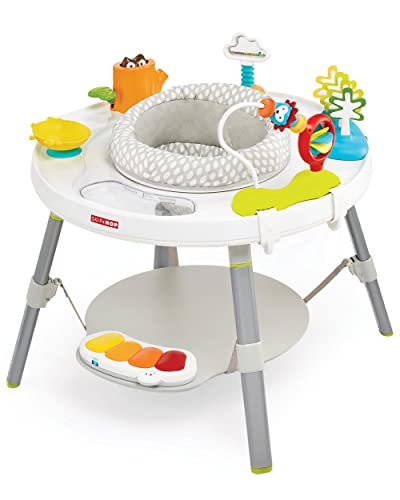
The Skip Hop Explore & More Activity Center grows with baby in three stages, from sitting play to an interactive cruise mode, and finally to a sturdy toddler table. It features a 360° rotating seat for easy access to 25+ developmental activities, including repositionable toy clips and loops for customization. The Discovery Window and a musical, light-up piano provide cause-and-effect learning through music and movement. Best for parents seeking a comprehensive, single-space center that adapts from infancy to toddler time. Caution: requires three AAA batteries (not included) for the piano’s light and sound features.
Who it’s best for: Families wanting a single, long-lasting activity center that can be used for playing, learning, and later coloring or crafts. It suits babies who can hold their head up and are not yet walking well, and it supports ongoing development as they grow.
Why chosen: It offers a 3-stage growth path, extensive manipulatives, and a seat that rotates completely to promote motor development and exploration. The modular toy loops let caregivers customize placements to fit a baby’s reach and abilities.
Limitation: The need for batteries to unlock full piano features means ongoing costs and replacements over time.
Skip Hop Silver Lining Cloud Activity Center

Designed in collaboration with a pediatrician, this center grows with the child through three stages and offers a 360° rotating seat with more than 25 activities. It emphasizes sensory exploration with a removable light-up piano that offers piano, song, and motion-sensor play modes. Best for families who want wide, varied activities and a playful discovery window for observing feet during play. Caution: like the Explore & More model, it relies on batteries to enable all features.
Who it’s best for: Parents looking for a feature-rich activity center with a strong emphasis on musical and sensory play, ready to engage with a rotating layout and flexible toy positioning.
Why chosen: The included discovery window and sequential stages give a robust progression path. It supports motor, cognitive, and sensory development with customizable toy placement.
Limitation: Battery-powered features add ongoing cost and maintenance considerations.
Baby Einstein Around We Grow 4-in-1 Walker

This well-known option combines an activity center with a stationary walker, transforming from a seated play area into a walk-around sensory table and eventually into a toddler art table. With four modes of play and height adjustments, it supports babies from about 6 months up to three years. Best for households needing a multisensory center that also functions as a walker for early mobility. Caution: transitions between modes should be supervised to ensure stability during changes.
Who it’s best for: Families seeking a single, convertible platform that can accommodate both seated play and early walking exploration.
Why chosen: The 4-in-1 design provides long-term value, accommodating growth from sitting to standing and creative play as a toddler.
Limitation: The setup and transitions may require guidance to ensure smooth conversions between modes.
Little Acorn 4-in-1 Activity Center (Sun)
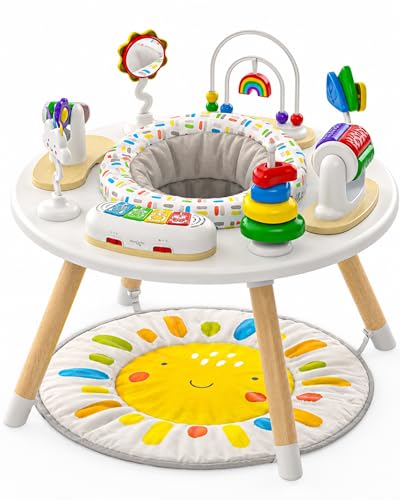
This Montessori-inspired center grows from tummy time to a toddler table with four play modes. It includes eight Montessori toys and a responsive Interactive Learning Piano with over 30 phrases and songs. Batteries are included so play can begin immediately. Best for parents who value a Montessori approach and removable toys for easy cleaning. Caution: some assembly and toy removal may be needed for older children or quick transitions.
Who it’s best for: Families seeking an educational, long-lasting center with well-curated toys and a focus on self-directed exploration through a Montessori lens.
Why chosen: The four-stage setup and high toy count provide a rich, varied play environment that remains engaging through different developmental milestones.
Limitation: Mixed materials and multiple parts may require more thorough cleaning and maintenance than simpler centers.
Little Acorn 4-in-1 Activity Center (Rainbow)

Similar to the Sun version, this rainbow variant emphasizes eight Montessori toys and an interactive piano, with easy cleaning and assembly features. It supports engagement from tummy time to toddler table and includes many activities to stimulate movement, language, and fine motor skills. Best for households prioritizing easy cleanup and a cheerful, colorful design. Caution: ensure all parts are securely assembled before use with an active toddler.
Who it’s best for: Parents who want durable, Montessori-aligned toys and straightforward maintenance, suitable for a broad age range.
Why chosen: The combination of Montessori toys and a robust piano helps with cognitive and motor development while remaining approachable for caregivers.
Limitation: Some users may prefer more advanced electronic features beyond the included piano.
Buying Guide: Key Considerations When Choosing a Baby Activity Center
- Growth and versatility: Look for multi-stage cores that transition from infant play to toddler use to maximize value and space.
- Movement and accessibility: A 360° rotating seat improves access to toys and promotes gross motor skills; ensure the center offers adjustable toy placement to match baby’s reach.
- Engagement features: Musical elements, discovery windows, and sensory stations can aid cause-and-effect learning and keep attention longer.
- Safety and setup: Check height adjustments, stability, and whether the item requires batteries for motion or lights. Ensure all parts are easy to assemble and clean.
- Materials and care: Removable fabric seats and washable components simplify maintenance. Consider machine-washable parts for busy households.
- Space and layout: If you have limited play space, a compact model that converts to a table may be ideal. For larger rooms, models with more toys may be better.
FAQ
- What age should I start using an activity center?
Most centers are designed for babies around 4–6 months who can hold their head up and sit upright with support, and continue through toddler years. - Do activity centers help with development?
Yes. They promote gross and fine motor skills, hand-eye coordination, sensory exploration, and early cognitive development through interactive play. - Are there any safety concerns?
Supervise play, ensure stability on flat surfaces, and avoid overstimulation from too many lights or sounds if the baby becomes fussy. - How long can I use a center before replacing it with a table?
Many three-stage models are designed to grow with your child for 2–3 years or more, eventually converting to a craft or table surface for coloring and activities. - What maintenance is required?
Regular cleaning of removable seats and toys, checking for worn parts, and battery replacements when applicable.