Answering the question: which baby walkers are best for girls, based on safety, versatility, and age-appropriate features? This guide highlights five walkers that suit young toddlers who are starting to stand and move. Each option targets girls with age-appropriate design, comfort, and engaging activities. The top picks balance supportive seats, adjustable heights, removable toy elements, and easy storage. The buyer’s note clarifies who each walker is best for, such as first walkers, toy-loving toddlers, or space-conscious families.
Growing baby needing multiple modes
| Product | Best For | Why It Stands Out | Storage/Portability |
|---|---|---|---|
| Smart Steps Trend Activity Walker with Emily Pink | New walkers who prefer pink accents | Removable toy bar and large tray, multi-directional wheels | Flat fold frame for storage |
| Bright Starts JuneBerry Walk-A-Bout | Toddler with on-the-go curiosity | Removable electronic toy with lights and melodies | Easy fold for compact storage |
| INFANS 5-in-1 Walker (Pink) | 5-in-1 design including sit, walk, bouncer, rocker, activity center | 3 adjustable heights | |
| Smart Steps Trend Plus 2-in-1 Walker Orbits Pink | Active toddlers needing STEM toy play | Removable STEM toys and large tray | Three height positions |
| Bright Starts Minnie Mouse 2-in-1 Walker | Disney-loving toddlers | Removable toy station with interactive elements | Easy fold and portable |
Smart Steps Trend Activity Walker: Emily Pink

Best for first-time walkers who enjoy bright, engaging visuals. This model features a removable toy bar with included toys, a large surround tray for snacks or toys, multi-directional front wheels, and a three-position height-adjustable, high-back padded seat. The flat fold frame aids storage when not in use. Suitable for ages 6 months and up, this walker emphasizes stability and simple transitions from sitting to standing. Caution: ensure the toy bar is securely attached for younger infants who may tug play elements.
Bright Starts JuneBerry Walk-A-Bout

Best for toddlers who enjoy interactive play on the go. The JuneBerry Walk-A-Bout includes a removable electronic toy with lights, melodies, and sounds. It supports babies from 6 months and up to about 26 pounds; the high seat back adds comfort during longer play sessions. It can be used for floor play or mobility-assisted exploration. Caution: electronic toys may require battery replacement over time for continued engagement.
INFANS 5-in-1 Behind Walker (Pink)
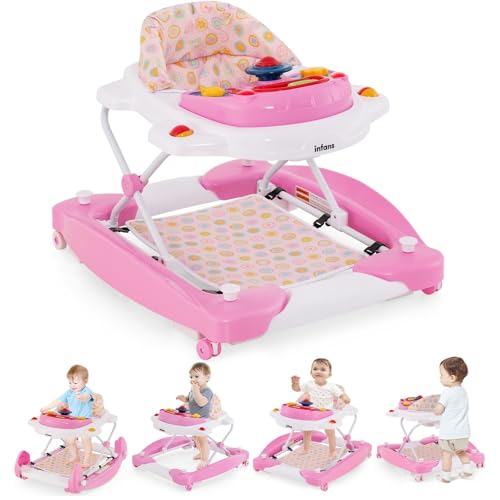
Best for growing babies who benefit from multiple configurations. The INFANS 5-in-1 design converts between a walker, bouncer, rocker, seated activity center, and a walk-behind option. It offers three adjustable heights (14.5”, 15”, 16”) to fit various heights and stages. Included features include a washable seat cushion and a foldable activity center. Caution: ensure all modes are correctly locked before use to maintain stability on different floor surfaces.
Smart Steps Trend Plus 2-in-1 Walker (Orbits Pink)

Best for toddlers who want a broader play tray and STEM-inspired toys. The Trend Plus 2-in-1 offers removable STEM toys, a large surround tray with snack space and a cup holder, and three-height adjustments. It sides with a walk-behind option and a flat fold frame for storage. Choose this if your child enjoys hands-on activities during movement and you want portability. Limitation: STEM toys may require supervision to avoid small parts detaching during play.
Bright Starts Minnie Mouse 2-in-1 Walker

Best for Disney-loving toddlers who want a familiar character by their side. This 2-in-1 walker transitions easily from an active walker to a seated toy station. It includes a removable toy station with a spinning beads activity, a light-up steering wheel, and a baby-safe mirror. The walker supports growth from sitting to standing and walking. Caution: ensure the toy station is attached securely to prevent accidental detachment during active use.
Buying Guide: Key Purchase Considerations
- Age and developmental stage: Look for walkers designed for babies as young as 6 months who can sit up and hold head control, and ensure the product supports the transition to standing and walking.
- Adjustable height: Choose options with multiple height settings to fit your child as they grow taller, ensuring ankle comfort and proper posture.
- Stability and safety: Prioritize wide bases, sturdy frames, padded seats, and secure locking mechanisms for different play modes.
- Engagement features: Removable toy bars, electronic toys, music, lights, and STEM elements can encourage exploration and motor development.
- Portability and storage: Flat-fold frames and lightweight construction help when you need to store or travel with the walker.
- Hygiene and maintenance: Removable cushions and easy-to-clean materials simplify upkeep for busy households.
- Usage limits: Use under supervision and on safe, flat surfaces; avoid stairs and open spaces without barriers.
FAQ
- What age should my child start using a baby walker?
– Typically around 6 months, when they can sit up with some head control and show interest in standing or moving. - Are walkers safe for girls who are not yet walking independently?
– Yes, many models are designed for sitting, standing support, and assisted movement, but always supervise and use on flat, clear floors. - What features are most important for a first walker?
– A stable base, height adjustability, a comfortable seat, and engaging activities to promote reach and grasp. - Can walkers replace playtime with a toy station?
– Walkers with removable toy stations offer a combination of mobility and seated play, which can extend engagement. - How do I store a walker when not in use?
– Choose models with flat fold frames; store in a closet or corner to save space. - Should I avoid walkers altogether?
– Walkers can be appropriate for supervised play; consider product design, safety features, and parental guidance to decide.