Answering the key question of which curved toddler spoons best support self-feeding, this guide focuses on user-friendly options for different needs. The top picks include utensils tailored for early self-feeding, gentle gums, and easy grip for tiny hands. This selection is ideal for parents seeking durable, dishwasher-friendly gear that helps toddlers progress from soft dippers to full, independent eating. The following table highlights five products most relevant to curved toddler spoons, along with their primary strengths and suitability for various buyers.
| Product | Best For | Why It Stands Out |
|---|---|---|
| Nuby Toddler Spoons And Forks Set | First-time self-feeders | Bright colors, easy-grip handles, dishwasher safe |
| PandaEar 6-Pack Bendable Spoons & Forks | BLW beginners and left/right-handed toddlers | 360° bendable neck, shallow scoops, gum-safe design |
| Deejoy Toddler Utensils With Travel Case | Travel-friendly practice users | Heat-resistant, bendable, palm-friendly grip |
| KINGSTONE 2-Piece Curved Stainless Steel Set | Long-term use and durability | 18/10 stainless steel, right-handed curved design, dishwasher safe |
| CHENGU Bendable Set | Learning bend-and-reach feeding | Flexible, safe, travel-friendly with case |
Nuby Toddler Spoons and Forks Set for Self-Feeding

The Nuby set includes a four-pack of spoons and forks designed for early self-feeding. The handles are sized for little hands, and the bright colors appeal to toddlers during meals. The utensils are marketed as easy to clean, with top-rack dishwasher compatibility highlighted for convenience. Best for: caregivers prioritizing simple, ready-to-use utensils with engaging colors for new self-feeders. Limitation: no detailed data on material composition beyond general safety claims.
PandaEar 6-Pack Bendable Spoons & Forks

PandaEar’s set emphasizes 360° bendable necks, with no spring-back mechanism. This design lets caregivers adjust the angle to help toddlers scoop from any food position. The handles are chunky and non-slip, facilitating a natural fist grip. Best for: families seeking flexible utensils that adapt to a child’s evolving grip and dining style. Limitation: internal bending mechanisms require careful cleaning to avoid food buildup and ensure longevity.
Deejoy Toddler Utensils With Travel Case
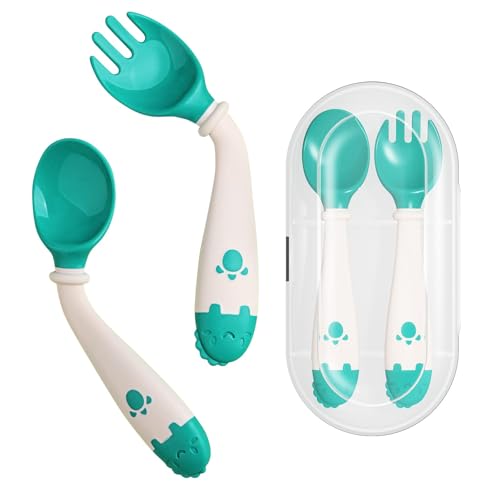
Deejoy’s set features silicone bendable handles and a travel case for on-the-go meals. The design emphasizes grip stability and gum safety with rounded edges. It is suitable for kids aged 6–18 months seeking to improve mouth coordination and feeding confidence. Best for: households needing a travel-friendly option that still supports self-feeding practice. Limitation: product descriptions emphasize grip and angle control, but long-term durability contingent on care and cleaning practices.
KINGSTONE Toddler Utensils Set

KINGSTONE offers a two-piece curved stainless steel set designed for right-handed toddlers. The 18/10 stainless steel construction provides durability and a mirror-polished finish. The curved handles are intended to reduce spills and support early self-feeding. Best for: parents seeking a long-lasting metal option with smooth edges and dishwasher safety. Limitation: the design favors right-handed use, which may feel less natural for left-handed children.
Buying Guide
What should you evaluate when choosing curved toddler spoons?
- Age and skill level: Start with gentle bends and thicker handles for early feeders, then move to more refined shapes as coordination improves.
- Grip and ergonomics: Look for chunky, non-slip handles and rounded edges to protect delicate gums and teeth.
- Material safety: Prioritize BPA-free, food-grade materials and dishwasher-safe designs for easy cleaning.
- Durability: Stainless steel options last longer, while silicone and plastic bendable styles offer flexibility for developing motor skills.
- Versatility: A travel case or easy-clean options help families with on-the-go meals and daycare use.
What should you consider about bendable vs non-bendable designs?
Bendable utensils can guide food toward the mouth from multiple angles, which helps infants who are still developing wrist flexibility. However, bendable designs may require careful cleaning to prevent residue buildup and may have a shorter lifespan if the joints wear or loosen over time.
Which features support early self-feeding?
Look for wide, shallow scoops to control portions and reduce gagging risk, rounded edges to protect gums and teeth, and ergonomic handles sized for little hands. A bright color palette can also encourage engagement during mealtime.
FAQ
- Are curved spoons safe for toddlers? Yes, when made from food-grade materials with rounded edges and no sharp points, these utensils are designed to be gentle on gums and teeth.
- At what age can a child start using bendable utensils? Many bendable designs are advertised for toddlers around 6–18 months and older, depending on the product. Always supervise feeding and adjust to a child’s developmental stage.
- Do bendable utensils work for left-handed children? Some models are designed to be ambidextrous or specifically left-handed-friendly, but others are optimized for right-handed use. Check product notes for handedness advice.
- Are metal utensils safer than silicone for beginners? Metal utensils are durable and easy to clean, but silicone variants are gentler on gums and teeth. Choose based on your child’s chewing and safety needs.
- Can these utensils be used with baby-led weaning (BLW)? Yes, many bendable and shallow-scoop designs support BLW by enabling easier grasp and controlled bites for self-feeding.
- Should I buy a travel case with toddler utensils? A travel case helps keep utensils clean when away from home and is convenient for daycare or trips.