Stop wondering which flashcards help babies learn best. The top options below are designed to boost vocabulary, early math, memory, and recognition in preschool-friendly formats. They suit parents seeking screen-free learning, caregivers guiding language development, and teachers building a quick daily practice. Each pick focuses on tangible concepts like letters, numbers, shapes, colors, animals, and first words. The table below highlights five strong choices to compare at a glance.
| Product | Best For | Key Benefit |
|---|---|---|
| Torlam Toddler Flash Cards | Young children (preschool) | Comprehensive set with alphabet, numbers, shapes, colors, animals, body parts, foods, and first words |
| Airbition Talking Flash Cards | Speech development (Montessori style) | 124+ illustrations with sound and 5-level volume control |
| ZazzyKid Flash Cards | Home learning for toddlers | 54 double-sided cards with alphabets, numbers, colors, and shapes |
| LearnWorx 101 Flash Cards | Structured early learning | 101 first words plus games to practice speech and recognition |
| Scholastic First Words Flash Cards | Foundational vocabulary | Simple, classic first words cards for early readers |
Torlam Toddler Flash Cards Bundle
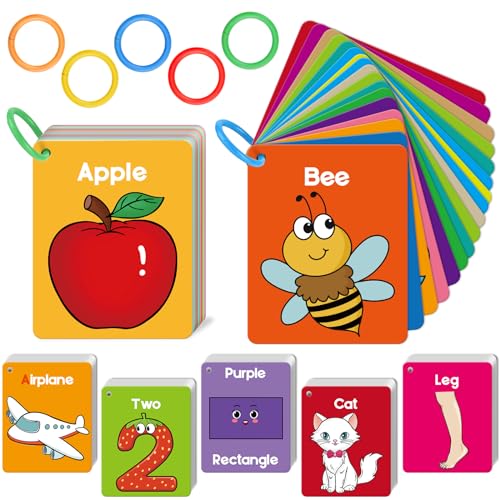
Torlam’s set includes 60 double-sided cards and five colored rings for easy organization. It covers the alphabet, numbers 1–10, shapes, colors, animals, first words, body parts, foods, and more. Best for toddlers starting preschool concepts and for caregivers who want a broad foundational toolkit in one purchase.
Best for: parents seeking a well-rounded starter pack that introduces core literacy and early math in a single kit. Better for: busy households needing quick rotation between topics. Choose this if: you want a durable, all-in-one set with simple, vivid illustrations. Caution: durability depends on handling; rings enable quick sorting but can be misplaced with heavy use.
Airbition Talking Flash Cards For Toddlers

Airbition’s talking flash cards combine visuals with voice prompts. With 224 words across animals, vehicles, foods, and more, this option supports speech development and auditory learning. The device features a standard American accent, a repeat button, and five volume levels, making it adaptable for various environments.
Best for: families focusing on verbal development and hearing-word–image associations. Better for: children who respond well to auditory cues. Choose this if: you want a tactile, interactive experience that can reinforce pronunciation. Caution: electronic components require care to avoid damage from rough handling and moisture.
ZazzyKid Flash Cards For Toddlers Learning

ZazzyKid offers 54 double-sided cards, including 26 alphabet cards, 10 number cards, 10 color cards, and 8 shapes. Lamination provides durability, and vibrant pictures with labels support quick association. It’s a practical choice for home learning and small group activities.
Best for: parents who want a compact, durable deck focused on core concepts. Better for: classroom warmups or quiet-time learning at home. Choose this if: you prefer clearly labeled visuals with strong color contrast. Caution: fewer topics beyond basic literacy and numeracy than larger kits.
LearnWorx 101 Baby Flash Cards

LearnWorx presents 101 first-word flashcards featuring animals, food, household items, places, and more. Each card’s reverse side includes a game idea to promote speech and recognition. The design supports early language development across ages from baby to pre-kindergarten.
Best for: families seeking breadth plus embedded games to reinforce learning. Better for: caregivers who want structured practice with varied prompts. Choose this if: you value award-winning design and large, colorful illustrations. Caution: some users may need additional practice for advanced vocabulary progression.
Scholastic First Words Flash Cards

Scholastic’s First Words pack focuses on foundational vocabulary with simple, early-reader cues. While compact, it supports gentle word introduction, making it a good match for very young learners who are just starting to link spoken and written language.
Best for: parents focusing on basic word recognition. Better for: a minimal, straightforward set that introduces core vocabulary. Choose this if: you want a clean, uncluttered approach to early word-building. Caution: fewer topics beyond first words compared with larger decks.
Buying Guide: Key Considerations For Baby Learning Flash Cards
- Purpose and age suitability: Choose sets that align with your child’s current stage—vocabulary-heavy kits for toddlers and language-focused decks for preschoolers.
- Durability and design: Look for laminated or sturdy cards with rounded corners; durable materials reduce wear from mouthing and frequent handling.
- Content breadth vs. depth: Decide between broad topic decks (alphabet, numbers, shapes, animals) and deep-dive sets focused on a few areas to build confidence.
- Interactivity: Cards with sounds, textures, or reversible activities can enhance engagement and retention, especially for speech and sensory development.
- Portability and organization: Rings, binders, or compact sizes help keep cards organized and portable for on-the-go learning.
- Safety and materials: Ensure non-toxic inks and child-safe finishing, particularly for children who explore with their mouths.
- Teacher and caregiver support: Sets that include suggested activities or game ideas can extend learning beyond basic card use.
Frequently Asked Questions
- What age are flash cards best suited for? Most toddler and preschool sets target ages 1–5, with adaptations for individual development pace.
- Should I choose one comprehensive deck or several topic-specific decks? A combination often works well: a broad deck for initial exposure plus focused decks for targeted skills.
- Are talking flash cards more effective than traditional ones? Audio features can aid pronunciation and memory for some children, but traditional cards work well for visual associations too.
- How can I maximize learning with flash cards? Short, frequent sessions (5–15 minutes) with spaced repetition and hands-on games improve retention.
- How do I teach with double-sided cards? Use one side for recognition and the reverse side for quick prompts or simple questions like “What color is this?”
- What safety precautions are important? Supervise use to prevent chewing on small parts, and store cards in a secure, dry place to prevent damage.