Looking for a push walker that helps your baby practice first steps while staying engaged? This guide highlights five top options that are best suited for infants 6–12 months and older toddlers who are learning to walk. Each product offers age-appropriate activities, music, and interactive toys to boost motor skills, balance, and confidence. Below you’ll find clear comparisons, who each walker is best for, and practical buying considerations to help you decide.
Comparison Quick View
| Product | Best For | Key Benefit | Limitations |
|---|---|---|---|
| Fisher-Price Laugh & Learn Puppy Walker | Ages 6+ months, music-loving babies | 75+ songs and 7 activities | Music can be repetitive over time |
| Fisher-Price Laugh & Learn Sis Walker | Active explorers who enjoy hands-on play | Similar Smart Stages with multiple activities | Buttons and parts may require supervision |
| VTech Sit-to-Stand Learning Walker (Blue) | Sitters transitioning to standers | Removable tray for floor play | May be smaller for taller toddlers |
| HYES 5 in 1 Baby Push Walker | Babies ready for multi-mode play | 5 modes with adjustable speed | More complex setup for some buyers |
| QDRAGON 3 in 1 Walker & Activity Center | First steps with education-focused play | Detachable activity table and center | May be heavier for travel |
Fisher-Price Laugh & Learn Smart Stages Puppy Walker

Best for babies who respond to music and light-up features, this walker offers two play modes: sit & play and stand & walk. The Smart Stages system delivers 75+ songs, sounds, and phrases that teach letters, shapes, colors, numbers, and basic Spanish words. With seven hands-on activities, including a light-up piano and a friendly nose, this is a well-rounded option for early cognitive and motor development. Suitable for infants around 6 months and up, it encourages independent exploration as confidence grows. Caution: ensure supervision during active play to prevent tipping on uneven surfaces.
Fisher-Price Laugh & Learn Sis Walker
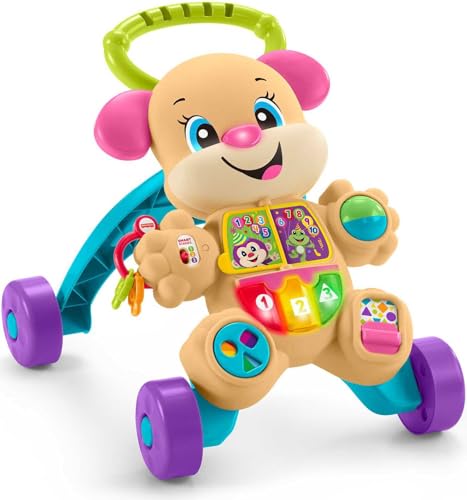
Best for babies who enjoy hands-on mystery and discovery, this sibling-friendly walker follows a similar Smart Stages approach with 75+ songs and interactive activities. The detachable light-up keys, nose, roller, spinner, and flip page provide varied stimuli to support fine motor skills and early language exposure. Choose this if you want a sibling-friendly alternative with the same developmental framework. Limitation: like other electronic walkers, the activity set will need occasional cleaning and battery care.
VTech Sit-to-Stand Learning Walker (Blue)
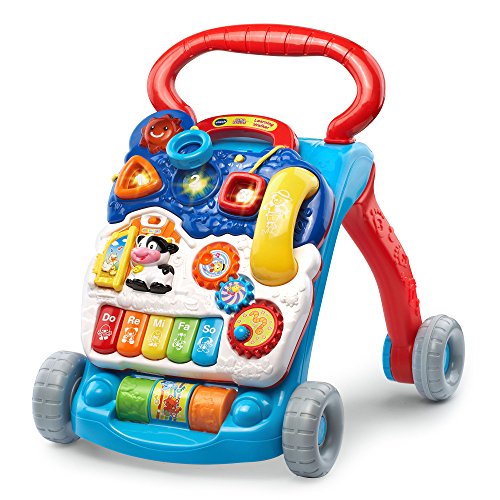
This walker is ideal for babies who begin sitting up and then move to standing. It features a removable activity panel that can be used on the floor for early play or attached to the walker for walking sessions. The five piano keys and a telephone handset support auditory training and role-play pretend play, while shape sorters and rotating rollers promote motor development. Best for small-to-medium rooms where a compact design helps navigate around furniture. Limitation: the detachable tray may be more engaging when used with the full walker in supervised sessions.
VTech Sit-to-Stand Learning Walker (Frustration Free Packaging)
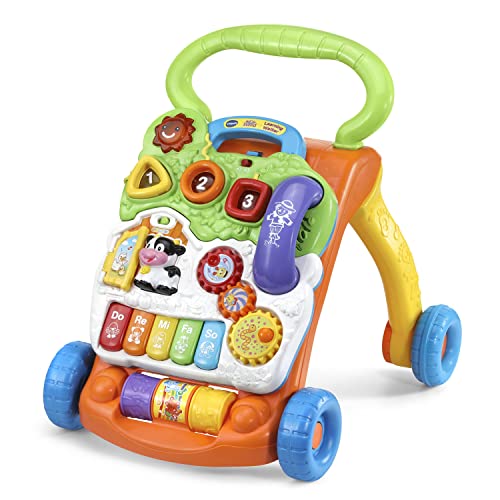
Similar to the blue version, this model emphasizes sit-to-stand progression with a detachable tray and five piano keys that emit musical notes. The included shape sorters, light-up buttons, and rotating rollers help develop gross and fine motor skills. Best for families seeking a budget-friendly option with the same foundational features. Caution: ensure small components are kept away from very young infants to avoid choking hazards.
HYES 5 in 1 Baby Push Walker

This upgraded 5-in-1 design offers five modes: baby walker, scooter, motorbike, a baby entertainment table, and an activity center. The removable play panel includes a basketball frame with three balls, shape blocks, spinning rollers, a piano keyboard, and more, encouraging color and shape recognition, rhythm, and creativity. Best for babies who will benefit from multiple form factors as they grow. Limitation: some parents may find assembly more involved, and the panel’s weight requires careful handling during transitions between modes.
QDRAGON 3 in 1 Walker And Activity Center

Best for parents seeking a 3-in-1 design that supports sit-to-stand progression with an attached activity center. It combines a walker, an entertainment table, and a hanging activity center. The detachable table includes turning cubes, shape recognition blocks, and a small bead track, while the bottom frame is designed to reduce tipping risk. Choose this if you want a robust, education-focused setup. Limitation: may be heavier and less portable than single-function push walkers.
Buying Guide
What features matter most in a push walker for baby development?
- Age and developmental stage: Look for models labeled for sit-to-stand progression and standing support as your child grows.
- Motor skill development: Prioritize walkers with shape sorters, spinning gears, and detachable panels that encourage reaching, grasping, and stepping.
- Learning content: If language exposure or music matters, consider models with songs, alphabet prompts, and multi-language options.
- Stability and safety: A wide base, low center of gravity, and non-slip surfaces reduce tipping risk on different flooring.
- Weight and portability: Lighter walkers are easier to move between rooms, while heavier models may feel sturdier.
- Detachable features: Removable panels or trays provide on-the-floor play versus walker-based play to adapt to space and activity.
What should you consider before buying?
- Room size: Ensure the walker fits through doorways and doesn’t obstruct high-traffic areas.
- Supervision: Active supervision is recommended during exploration, especially with older siblings around or on uneven surfaces.
- Cleaning: Removable panels and fabric components should be easy to wipe down for daily use.
- Durability: Choose solid construction with reinforced joints for growing babies who push harder as they learn to walk.
How to compare these models quickly?
- Best for music and language learning: Fisher-Price Laugh & Learn Puppy and Sis walkers.
- Best for floor play and portability: VTech Sit-to-Stand models.
- Best for multi-mode learning and activity variety: HYES 5 in 1 and QDRAGON 3 in 1.
- Best for stability and extended use: models with detachable activity centers and wide bases.
FAQ
- Q: At what age should a baby start using a push walker? A: Most are designed for babies around 6 months and older who can sit up, reach, and begin standing with support.
- Q: Are push walkers safe for all floors? A: Most are suitable for concrete, hardwood, and carpet, but always check the product’s safety guidelines and use on level surfaces.
- Q: Do walkers delay walking development? A: When used appropriately, walkers can support movement practice, but excessive time in walkers is not recommended; balance with floor play and supervised standing activities.
- Q: Should I prefer electronic or non-electronic walkers? A: Electronic walkers offer language and music prompts that can aid early learning, while non-electronic walkers emphasize physical development and play variety.
- Q: How important is a detachable tray or panel? A: Detachable components can increase play versatility and transition between floor activities and walker-assisted mobility.
- Q: Is assembly difficult? A: Some models require straightforward assembly; check included instructions and customer reviews for clarity before purchase.