Quiet books for babies and toddlers support screen-free exploration, tactile learning, and early cognitive development. This guide highlights five top options that balance sensory play, fine motor practice, and portability. Each pick suits a different type of shopper—from parents seeking Montessori-inspired activities to caregivers prioritizing high-contrast visuals for visual development.
| Product | Best For | Why It Stands Out |
|---|---|---|
| Melissa & Doug K’s Kids My First Activity Book | Tapers toward early learners and tummy-time play | 8-page cloth book with puppets, flaps, and multiple manipulatives for multisensory, screen-free exploration |
| Soft Baby Book With Touch And Feel Pages — ZICOTO | 0–18 months, sensory-first development | Crinkle textures, mirror, and varied textures for tactile and visual growth |
| Macabaka Montessori Soft Baby Book | Structured early learning and independent exploration | Montessori-inspired pages with 8 guided discovery activities and a movable element |
| beiens High Contrast Black And White Book | Newborns to 3–6 months focusing on visual development | High-contrast colors, mirror, and crinkle pages to stimulate early perception |
| Jollybaby 10 Page Busy Book | Travel-ready quiet book for toddlers | Travel-friendly, six-page layout with colorful scenes to support language and motor skills |
Melissa & Doug K’s Kids My First Activity Book

This soft activity book is ideal for babies and toddlers who benefit from multi-sensory exploration during tummy time or stroller rides. It includes removable hand puppets, finger puppets, a crinkling panel, a movable clock, and practical activities like buttoning and buckling. Best for parents seeking a Montessori-inspired, screen-free learning experience that supports fine motor skills and early problem-solving. Caution: Small parts may present a choking risk for very young infants; use under supervision.
Soft Baby Book With Touch And Feel Pages — ZICOTO

Designed for the 0–18 month window, this sensory book emphasizes touch, sight, and sound. The crinkle pages, soft textures, and baby-safe mirror stimulate visual and tactile development, making it a strong pick for sensory-rich tummy time. It’s best for caregivers who want a compact, highly engaging book that evolves with baby’s early months. Limitation: Some babies may prefer more interactive elements beyond the included flap and teether features.
Macabaka Montessori Soft Baby Book
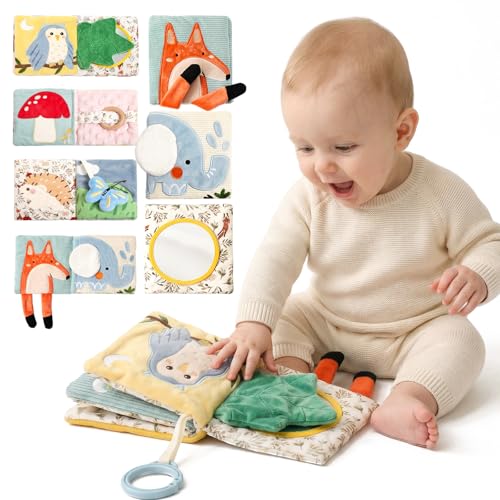
Rooted in Montessori principles, this book offers eight guided discovery pages designed to foster curiosity, focus, and cognitive growth during a baby’s first year. It features textured materials, a safe unbreakable mirror, and movable elements that promote hand-eye coordination. Best for parents seeking purposeful play that translates to early independence. Caution: Some pages include multiple textures; ensure occasional gentle cleaning to maintain fabric integrity.
beiens High Contrast Black And White Book

This high-contrast book targets newborn visual development with bold patterns and a baby-safe mirror. The crinkle pages and tactile elements support early perception and focus. Best for parents wanting a simple, durable option that remains engaging as baby’s vision matures. Limitation: Visual complexity is intentionally high-contrast; some babies may initially prefer softer color palettes as vision develops.
Jollybaby 10 Page Busy Book

Designed with travel in mind, this quiet book features six pages of bright, engaging scenes and activities. It’s well-suited for toddlers who benefit from language development, hand-eye coordination, and quiet, independent play on trips. Best for families needing a portable, compact option that still delivers Montessori-inspired activities. Caution: Some might outgrow the simple pages quickly; rotate with other materials to extend use.
Buying Guide
What should I look for in a quiet book?
- Age appropriateness: Match textures, buttons, and flaps to your child’s developmental stage.
- Durability: Look for reinforced stitching and washable fabrics for long-term use.
- Sensory balance: Consider a mix of touch, sight, and sound features to support multisensory learning.
- Portability: For travel or on-the-go use, choose compact designs with carrying handles.
- Safety: Avoid small detachable parts for babies under three; supervise young toddlers during play.
Montessori vs. Montessori-inspired: What’s the difference?
Montessori-inspired books integrate open-ended, self-directed activities but may incorporate non-Montessori elements. True Montessori books emphasize sequential activities that foster independence, practical life skills, and self-correction. Choose based on how much structure your child needs and how you want to support independent play.
How to use a quiet book effectively
- Introduce one activity at a time to avoid overwhelm.
- Pair quiet book play with routine moments (car rides, stroller walks, before-bedtime calm).
- Rotate pages to sustain interest and extend learning across months.
Materials and safety considerations
Look for BPA-free fabrics, non-toxic dyes, and sturdy stitching. For babies, ensure that there are no sharp edges or loose components that could pose a hazard during mouthing or rough handling.
Storage and maintenance
Choose books with built-in handles or zipper pouches to keep pages organized. Most cloth books are machine washable or spot-cleanable; follow manufacturer care instructions to maintain fabric integrity and textures.
FAQ
- What age is best for a quiet book?
Quiet books typically suit infants around 6 months and older, with evolving appeal through the toddler years as fine motor skills develop. - Are quiet books safe for babies who chew on toys?
Yes, when made from non-toxic fabrics and securely stitched components; always supervise to prevent choking hazards. - Which features are most effective for early learning?
Peek-a-boo flaps, texture variety, mirrors, and simple lacing or button activities support sensory development and hand-eye coordination. - Should I choose high-contrast or color-rich designs?
High-contrast designs benefit very young babies for visual development, while color-rich textures engage older infants and toddlers more broadly. - How long will a quiet book stay engaging?
Engagement length varies; rotating pages and introducing new activities can extend use across several months to years.