Answering the question “which sensory gym is best for babies,” this guide highlights five top options that support tummy time, fine and gross motor skills, and early sensory exploration. Each pick targets different needs—from compact portability to immersive multi-sensory experiences—so you can match the right gym to your little one’s stage and routines. Ideal buyers include new parents seeking safe, engaging ways to foster development, caregivers prioritizing easy cleaning, and families wanting a long-lasting play gym that grows with their child.
| Product | Best For | Why It Stands Out | Limitations |
|---|---|---|---|
| TFDER Baby Gym Play Mat | Newborn to 6-12 months | 8-in-1 design with detachable toys, self-discovery mirror, and foldable fence for a contained play area | Ball pit requires additional balls |
| Baby Einstein 4-in-1 Kickin’ Tunes Gym | Toddlers to 36 months | Music, language discovery, and multiple modes that grow with baby | Music features rely on piano; may be loud for some |
| URMYWO Tummy Time Mat | 0+ months to toddler | Six development zones with foldable, portable design and machine-washable materials | Some assembly required; larger footprint |
| Jyusmile 8-in-1 Baby Play Mat | Wide range from newborn to early toddler | Large surface with ball-pit capability (ball not included) and six removable toys | Ball pit needs balls separately |
| Lovevery Play Gym | Parents seeking Montessori-inspired setup | Stage-based zones and age-appropriate activity guidance | Higher price point |
TFDER 8-in-1 Baby Gym Play Mat

The TFDER play mat is designed for newborns to 12 months, with an 8-in-1 layout that includes tummy time, floor play, and a foldable surround fence. It ships with three sensory toys (giraffe, tree, elephant) with sound effects, a self-discovery mirror, and a tummy time pillow. The mat’s non-slip bottom enhances safety, and it’s made from phthalate-free materials for safer exploration. Best for curious babies who benefit from varied modes across milestones.
Who it’s best for: caregivers seeking a versatile, all-in-one setup that can transition from tummy time to enclosed play. Why selected: strong multi-mode design and included sensory toys support a broad range of early skills. Caution: ball pit usage is contingent on having balls (not included).
Baby Einstein 4-in-1 Kickin’ Tunes Gym
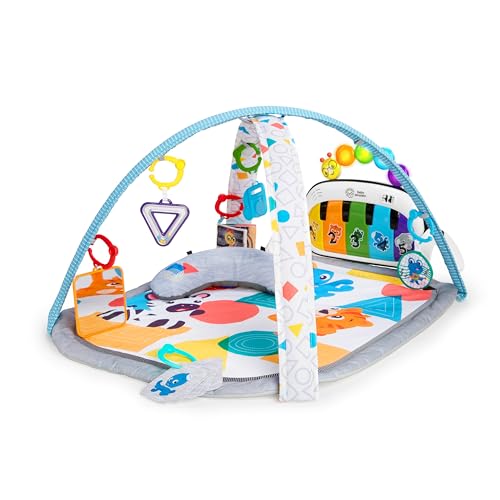
This activity gym grows with your child from 0 to 36 months, offering four modes: lay and play, sitting up, tummy time, and on-the-go. It features a piano with 25+ minutes of lights and music and introduces colors, shapes, and numbers in English, Spanish, French, and German. Seven sensory toys support reaching, pressing, and kicking for motor skill development. Best for: parents wanting language and music exposure integrated into play. Caution: music and lights can be loud for sensitive infants.
URMYWO Tummy Time Mat

URMYWO’s mat features six developmental zones designed to foster vision, hearing, and cognitive growth alongside motor skills. The materials are CPSIA-compliant, lead-free, and odor-free. The mat folds and is machine-washable for easy cleanup. Best for: families needing a durable, washable gym that can grow with a child from infancy to toddlerhood. Limitations: larger footprint may require more floor space.
Jyusmile 8-in-1 Baby Play Mat

Jyusmile offers an expansive 43″ by 39″ play surface with 6 removable toys, a tummy time moon, and a ball-pit-ready option (balls not included). The detachable toys promote visual, auditory, and tactile development, while the bright colors and sounds encourage exploration. Best for: parents needing a roomy gym that can function as a ball pit and explore diverse textures. Caution: ball pit feature requires separate ball purchase.
Lovevery Play Gym

Lovevery’s Play Gym emphasizes Montessori-inspired design with five development zones that reveal or conceal to manage stimulation. It includes a guide with age-appropriate activities and removable accessories like an organic ball, teether, a sustainable wood toy, and interchangeable learning card sets. Best for: caregivers seeking a premium, guided approach to stage-based learning. Limitation: higher price point may be a consideration for budget-conscious buyers.
Buying Guide
What should I look for in a baby sensory gym?
Key features include safe, non-toxic materials, a non-slip base, ease of cleaning, and a design that grows with your child. Look for detachable toys, a mirror for self-recognition, and a mix of textures and sounds to stimulate multiple senses. Consider the space you have and whether you want a compact mat or a larger play center that doubles as a ball pit.
Which features matter for different ages?
Newborns benefit from high-contrast visuals and soft textures. By 3–6 months, tummy time support and trackable toys help with neck and upper body strength. Around 9–12 months, interactive elements, cause-and-effect toys, and sit-to-stand activities become valuable. Choose a gym that offers modes or toys aligned with these milestones.
Care and safety considerations
Choose phthalate-free fabrics and a non-slip base. Check machine-washable components for easier maintenance. Ensure there are no small parts that could detach and pose a choking hazard. A foldable or enclosed design can minimize ball rolling and keep play spaces tidy.
Space, budget, and longevity
Measure your play area to avoid oversized mats that overwhelm a room. If you want a gym that lasts through multiple stages, consider models with expandable features, durable materials, and guidance on age-appropriate activities. Budget-friendly options can still deliver solid development support with varied toys.
Frequently asked questions
- What age is best for a sensory gym?
- Are these toys safe for babies?
- Do all gyms include a ball pit?
- How easy is it to clean?
- Which gym is best for travel?
Most gyms support infants from birth through toddler years, with features evolving in complexity as they grow.
Choose models with non-toxic materials and safety-tested components. Avoid small detachable pieces for younger infants.
Some models support ball pits as an optional feature or with additional accessories; confirm before purchase.
Look for machine-washable fabrics and removable toys. Wipe-down surfaces should be straightforward for quick resets between play sessions.
Portable, foldable designs with a compact footprint and lightweight materials are ideal for travel and easy setup.