Answering the question for parents seeking stationary activity centers, these picks offer age-appropriate, multi-stage play that stays put as a child grows. Best for parents wanting a versatile, space-conscious option that transitions from infant to toddler activities without needing multiple purchases. The top five below are chosen for varied features, durability, and play variety, each suited to different developmental needs and living spaces.
| Product | Best For | Why It Stands Out |
|---|---|---|
| Skip Hop Baby Activity Center: Interactive Play Center with 3-Stage Grow-with-Me Functionality, 4mo+, Explore & More | Infants to early toddlers | Three-stage design with a 360° rotating seat and 25+ activities encourages progression from sitting to cruising and eventual toddler table use. |
| Skip Hop Baby Activity Center: Interactive Play Center with 3-Stage Grow-with-Me Functionality, 4mo+, Silver Lining Cloud | Infants to early toddlers | Similar grow-with-me design with a different theme; extensive layout supports motor, cognitive, and sensory growth. |
| Baby Einstein Around We Grow 4-in-1 Walker, Discovery Activity Center and Table | Infants to toddlers | 4-in-1 versatility with walking support and a convertible play table, supporting multiple play modes over years. |
| Dream On Me 2-in-1 Baby Activity Center & Bouncer Jumper | Active infants to early crawlers | 360° rotating seat with bouncer/jumper options, multi-height design, and melodic lights for engagement. |
| Little Acorn 4-in-1 Baby Activity Center | Montessori-Inspired Design | Infants to toddlers | Montessori-inspired, modular 4-in-1 design with 8 interactive toys and a focus on self-guided discovery. |
Skip Hop Baby Activity Center: Explore & More (3-Stage)
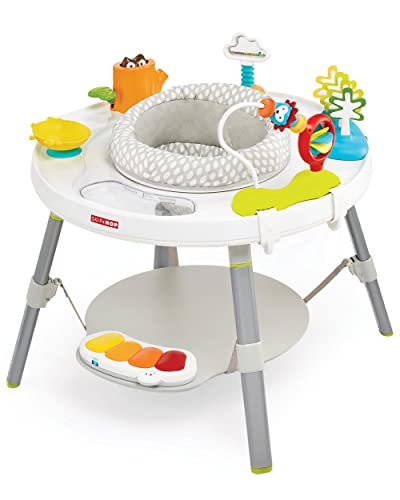
The 3-stage grow-with-me design starts at 4 months and supports up to 25 lbs. Stage transitions are Sit, Swivel & Play; Cruise & Interact; and a toddler activity table. The 360° rotating seat provides easy toy access and promotes motor development.
Best for: Parents who want a single, long-term center that evolves with the child, offering constant access to varied toys as they reach new milestones.
Limitations: Requires 3 AAA batteries for the light-up piano; batteries not included. Consider battery needs and replacement planning in advance.
Skip Hop Baby Activity Center: Silver Lining Cloud Edition

This version mirrors the grow-with-me approach with extensive activity stations and a 360° seat. It emphasizes sensory exploration and motor development through more than 25 developmental activities and rearrangeable toy loops.
Best for: Families seeking strong customization and hands-on engagement, with emphasis on fine motor and sensory learning as the baby grows.
Limitations: Like other centers, it relies on battery-powered features for some toys, so plan for replacements as needed.
Baby Einstein Around We Grow 4-in-1 Walker

This multisensory center doubles as a stationary activity table and a walkable center, growing with baby from 6 months to around 3 years. It offers four play modes, including a sit-in walker for mobility exploration and a toddler table for art and imaginative play.
Best for: Parents who want a highly adaptable setup that transitions from floor play and exploration to a table-based activity area without swapping equipment.
Limitations: The walker mode can be bulky; ensure enough floor space for safe rotation and movement.
Dream On Me 2-in-1 Activity Center & Bouncer Jumper

Featuring a rotating seat and a 360° play area, this center supports early motor skills and engagement through lights and sounds. It offers adjustable height and a wide base for stability, with 12 melodies for added sensory reinforcement.
Best for: Families seeking an economical, space-saving option with a strong focus on music, lights, and movement to attract a child’s attention.
Limitations: Might not offer as many distinct toy stations as larger centers; better suited for babies who respond to musical cues and visual stimuli.
Little Acorn 4-in-1 Activity Center
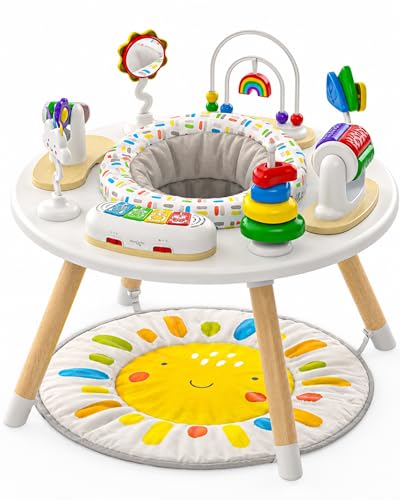
Montessori-inspired and modular, this 4-in-1 center grows with baby through tummy time, exploratory play, and a toddler table. It includes 8 interactive toys and a responsive interactive piano with over 30 phrases, sounds, and songs. Batteries are included for immediate use.
Best for: Parents who prefer a Montessori-style approach and a program that evolves from sensory tummy time to independent table play, with easily removable toys for customization.
Limitations: Some users may prefer more traditional shapes or seating arrangements; ensure the modular design fits your space and workflow.
Buying Guide: Key Considerations For Choosing A Stationary Baby Activity Center
- Age and growth trajectory: Look for a center that grows with your child from infancy to toddlerhood without requiring major replacements.
- Number and type of activities: Prioritize centers with a mix of motor, cognitive, and sensory activities, plus adjustable toy placement to accommodate evolving abilities.
- Stability and safety: A low, wide base and non-slip feet reduce tipping risk. Check for BPA-free materials and certified safety standards where available.
- Space requirements: Measure floor space before purchasing; some multi-stage centers can take up substantial room when fully set up.
- Maintenance and cleaning: Removable, washable seat pads and toy surfaces simplify cleanup and hygiene.
- Battery use and power needs: Several features rely on batteries; plan for replacements and consider centers with non-battery play modes as alternatives.
- Ease of transition: Centers that clearly delineate stages (Sit, Swivel, Cruise, Table) reduce setup time and confusion for caregivers.
- Storage flexibility: Some models convert into tables or separate toys; consider if you’ll reuse components as your child grows.
Frequently Asked Questions
- What is a stationary activity center for a baby?
- At what age should I start using an activity center?
- Do these centers help with development?
- How do I choose the right one for a small space?
- Are these centers safe for babies who are crawling or walking?
- How should I clean and maintain a baby activity center?
A stationary activity center is a play station designed to stay in one location while offering multiple toy stations, music, lights, and activities. It typically supports infants through toddlers and may convert to a table or different play modes as the child grows.
Most centers are suitable from about 4 to 6 months, depending on the baby’s ability to hold their head up unassisted. Always follow the manufacturer’s age and weight guidelines.
Yes. They support motor skills (grasping, reaching, swiveling), cognitive growth (cause-and-effect, sensory exploration), and social interaction through play patterns and music or storytelling elements.
Choose compact designs with a clear growth path and modular components. Look for centers that can transition to a toddler table to maximize space efficiency.
Many centers are designed to adapt as babies begin cruising and standing. For crawling or walking babies, ensure the unit’s height and seating are appropriate and that the baby is supervised at all times.
Follow the manufacturer’s cleaning instructions. Most toys detach for hand washing, and seats with fabric components should be spot-cleaned and air-dried to prevent mildew and odors.