Looking for the best walker for a 12-month-old? This guide highlights top sit-to-stand and push walkers that support early walking, hand-eye coordination, and cognitive development. Each product is chosen for different needs: best for budget, best for interactive learning, best for natural wooden construction, best for adjustable features, and best for multi-function play. Ideal buyers include: first-time parents seeking simple features, caregivers prioritizing interactive toys, and those wanting sturdy, long-lasting construction that grows with a child. Below, compare five popular options and see which fits your child best.
| Product | Best For | Why It Stands Out |
|---|---|---|
| Smart Steps Trend Activity Walker | Active toddlers needing room for toys | Large tray, removable toy bar, multi-directional wheels, adjustable height |
| VTech Sit-to-Stand Learning Walker (Blue) | Interactive learning on the go | Detachable tray, music, shape sorters, multi-skill development |
| Fisher-Price Laugh & Learn Puppy Walker | All-in-one learning toy | Two play modes, 75+ songs, letters, colors, numbers |
| Bautia Wooden Baby Walker | Natural wood and quiet wheels | Sturdy, silent wheels, multiple activity panel |
| HYES 5 in 1 Baby Push Walker | Versatile use and learning | Five modes, adjustable speed, educational activity panel |
Smart Steps Trend Activity Walker With Removeable Toy Bar

The Smart Steps Trend Activity Walker is designed for babies who are starting to explore mobility. It features a removable toy bar with engaging toys, a large surround tray for snacks or toys, multi-directional front wheels, and a three-position height adjustment with a high-back padded seat. This model is best for parents who want a bright, exercise-friendly walker that can be stored easily thanks to a flat-fold frame. The plush seat helps comfort during longer sessions of play or practice standing.
Best for: caregivers seeking a budget-friendly, compact walker with built-in toys and straightforward height adjustment. Why selected: the combination of a wide tray, removable play bar, and adjustable height supports growth from sitting to steady steps. Limitation: the toy bar is removable, but may not offer as many educational features as some learning-oriented models.
Key features at a glance:
- Removable toy bar with included toys
- Large tray for food or toys
- Multi-directional front wheels for easy maneuvering
- Three-position height adjustment
- High-back padded seat for comfort
VTech Sit-to-Stand Learning Walker (Frustration Free Packaging) – Blue
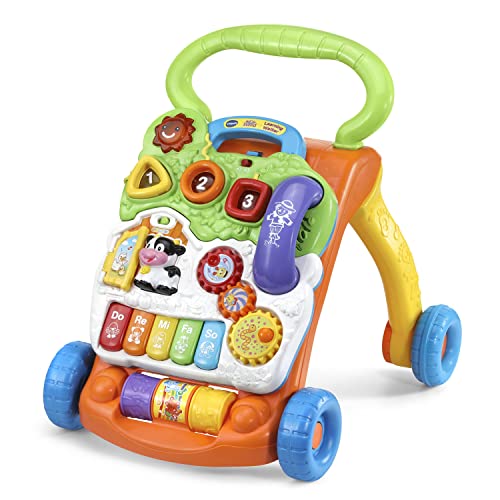
The VTech Sit-to-Stand Learning Walker focuses on early educational play during walking development. It offers a detachable tray panel that can be used on the floor or attached to the walker for on-the-go exploration. The activity center includes five piano keys that play musical notes and a pretend telephone handset to boost imaginative play. This model also features three shape sorters, light-up buttons, and colorful spinning rollers to help develop motor skills and hand-eye coordination.
Best for: families prioritizing multimedia learning, music, and role-play as a child learns to move. Why selected: the interactive panel encourages exploration while the walk helps build leg strength. Limitation: some parents may prefer more durable, non-toy-based surfaces for rough floors.
Key features at a glance:
- Removable tray that attaches to the walker
- Auditory training with musical keys and a pretend phone
- Motor development aids: shape sorters, light-up buttons, spinning rollers
Fisher-Price Laugh & Learn Smart Stages Puppy Walker

The Fisher-Price Laugh & Learn Puppy Walker blends walking support with a robust talking and singing experience. It offers two modes of play: sit-and-play and stand-and-walk, making it suitable for babies who are just starting to stand and for those who already enjoy exploring on their feet. The toy includes 75+ songs, sounds, and phrases that cover basics like the alphabet, shapes, colors, and numbers, with some Spanish words for bilingual exposure. Hands-on activities such as an interactive nose, piano keys, a roller, spinner, and flip pages keep little ones entertained.
Best for: parents seeking a high-toy-count, musically rich option that grows with their child. Why chosen: the Smart Stages learning system aligns with developmental milestones. Caution: the volume can be loud; use settings to suit quiet play areas.
Key features at a glance:
- Two play modes to grow with child
- 75+ songs, sounds, and phrases
- 7 hands-on activities including light-up piano keys
Bautia Wooden Baby Walker

The Bautia Wooden Baby Walker is a Montessori-inspired option featuring natural wood, smooth edges, and a sturdy frame. It includes a lively interactive panel with a rolling letter wheel, xylophone, flip board, and a tracking game, offering multiple activities to engage a baby while supporting first steps. The walker’s rubber wheels are described as silent and floor-friendly, reducing scuffing on hard surfaces. This option emphasizes a more classic, natural look and a stable walking experience for early walkers.
Best for: households prioritizing natural materials and a quiet, stable walking aid. Why selected: the wooden design enhances durability and a traditional look, with multiple activities to support learning. Limitation: wood construction can be heavier and less adjustable than plastic counterparts.
Key features at a glance:
- Natural wood with rounded edges
- Silent rubber wheels
- Interactive panel, letter wheel, xylophone, flip board
HYES 5 in 1 Baby Push Walker

The HYES 5 in 1 Baby Push Walker is a versatile option offering five distinct modes: baby walker, scooter, motorbike, baby entertainment table, and activity center. Its adjustable speed is controlled by a non-slip, shock-absorbing rubber ring, and a rear wheel button allows speed adjustments to match a baby’s walking stage. The removable play panel includes a basketball frame with three balls, blocks, spinning rollers, a piano, and other features to promote color and shape recognition, rhythm, and creativity. This is a strong choice for growing with a child across stages.
Best for: parents needing a multi-mode walker that adapts as a child learns. Why selected: the design supports progression from sitting to standing and walking, with a robust educational panel. Limitation: the setup may be more complex than simpler walkers for very early walkers.
Key features at a glance:
- 5 modes in 1 design
- Adjustable speed with non-slip wheels
- Detachable activity panel with educational toys
Buying Guide: What to Consider When Choosing a Walker
- Age and development stage: Ensure the walker supports sit-to-stand transitions and upright walking.
- Safety and stability: Look for wide bases, secure height adjustments, and smooth, floor-friendly wheels.
- Adjustability: A walker that grows with your child reduces the need for a replacement as skills develop.
- Educational value: Consider built-in activities, sounds, music, and language exposure.
- Portability and storage: Flat-fold frames and compact designs help with storage in small spaces.
- Materials: Wood and plastic options offer different aesthetics, weights, and durability profiles.
- Maintenance: Removable toys and easy-clean surfaces simplify cleanup after spills or drool.
Frequently Asked Questions
- When should I start using a walker for my baby?
Answer: Most babies begin using a walker as they start standing with support, typically around 6–12 months, depending on development and safety readiness. - Are wooden walkers safer than plastic ones?
Answer: Both can be safe when used under supervision. Wooden walkers often emphasize durability and natural materials, while plastic models may offer more adjustable features and lighter weight. - Do walkers delay walking?
Answer: No clear evidence shows walkers delay walking when used appropriately. Always supervise and limit usage to short, safe sessions. - What features are most important for a 12-month-old walker?
Answer: Stability, adjustable height, age-appropriate activities, and ease of cleaning are key considerations. - Can walkers be used outdoors?
Answer: Some models are designed for indoor use, while others tolerate short outdoor sessions on smooth surfaces. Check product guidelines for outdoor safety. - How do I know which walker is best for my child?
Answer: Match features to your child’s interests—musical and interactive toys for curious infants, or a simpler design for a quick first walker.